Saturday, November 23, 2013
Sharing wWeb Resources
Just right on time, I received a newsletter from zero to three that discussed about a virtual rally organised focusing on babies and toddlers development. One major emphasis was that learning starts as early as at birth. Therefore, government and individuals should pump in more money into early childhood so as to achieve a quality program. The rally yielded a positive response as about 40,000 people showed interest in asking the government to invest in early childhood and be more concerned with every child's growth and development. Indeed, quality early childhood program has come to stay seeing people are showing so much interest and support. Even as I aim at becoming a policy maker in EC Field, I can see how influential this position could be and I hope to make policies that would be beneficial to every child and family.
I join ZeroToThree in celebrating the military month (November) and pray God to uphold and protect military families.
It is very sympathetic that only 4% of eligible children attend head start (zeroto three). This makes it clear that only the government might not be able to achieve a quality early childhood program that will serve all children. Hence, I think policy makers should make policies that will include privately owned children centres insisting on quality standards, While the government makes plans to build more centres.
Brain development is a research project of neuroscientists. On almost every page of the zerotothree has it that the first three years of human is the fastest growing stage where the brain develop so quickly. Emphasis are made on types of toys to buy; building on emotional development; improving on play and creating more positive experiences from birth to age 3 in order to build healthy and creative brains.
From the issue of funds, I can see that parents are identifying with this issue which might give it a quick attention and consideration. As a result, quality early childhood will sweep around the whole nation with every child benefiting.
Resource
www.ZEROTOTHREE.com

Saturday, November 16, 2013
Poverty in China

I am yet to receive any confirmation mails from my international contacts. But I hope to exchange information with Janella, a classmate as we continue with this course. She lives at Michigan and works in Early Head Start.
A study on poverty in China(the most populous Nation in the world) reveals that even the poor are interested in giving education to their children even if not the best standard.This could also account for the reason why poverty is reducing in recent times. Rural poverty decreased from about 30.7% to about 3.7% and just about 4 - 8% live in poverty in Urban areas in 2001; and in general, 5% of the whole population live below the poverty line. Like in most countries, the major reason for poverty in China is unemployment.
Also they acknowledge the fact that investing in early childhood education is a way of reducing poverty.
Interestingly, the government allocates a piece of land to every rural family, relief some families of paying agricultural taxes when farm produce is poor and then provide food, clothing and shelter for the very poor families. But the government needs to consider children from the rural areas in terms of education as poor children in rural areas account for the majority part of poor children as a whole in China. Unfortunately, poor children in rural areas are prevented from going to school due to some extra cost fees placed on education, hence in order to cope about 70% of them cut down on their food intake, borrow from friends and relatives, rather than wait solely on the government.
It is obvious to me now that poverty is a global issue. Though it is conspicuous in most African and Asian countries, I am beginning to see that poverty exists in every community and the role of the government is crucial in eradicating poverty.
References
http://www.childhoodpoverty.org/index.php?action=country
http://www.childhoodpoverty.org/index.php/action=documentfeed/doctype=pdf/id=83/
Saturday, November 9, 2013
Sharing web resources
Zero To Three (www.zerotothree.org) as a non-profit organisation deals with issues about infants/toddlers, parents and families, EC professionals and policy makers. They recognise the fact that the first three years of one's life has so much effects on the later years, hence Zero To Three help parents and EC professionals in bringing about children's development at this early stage.
One of the news letters I read this week talked about how states can be involved in infants/toddlers education. Achieving and sustaining a quality program has been emphasized in our program, hence I thought it useful to use this check list in observing what states are doing for children in the US and to get ideas that I could use in my country in order to help raise the standard of infant/toddler care. Knowing states have a major role to play in achieving quality in early childhood field, EC professionals must maintain a flow of communication with the government to ensure issues are well handled.
This week I decided to work on traumatised (or war affected) children in our application. It aroused my interest when I saw an article on Zero to Three stating what some states are presently doing with regards to this issue. Though not necessarily children that were involved in war per se, but children who have been maltreated one way or the other are being catered for by some states. It gladdens my heart that some states train EC professionals for this task. Knowing that traumas cause developmental set backs for children, then it is worth tackling.
References
ZERO TO THREE (2013). Ensuring assessment services for all maltreated for all infants and toddlers. Retrieved from http://www.zerotothree.org/policy/docs/ensuring-assessments-and-services.pdf
ZERO TO THREE (2009). Infants and toddlers in the policy picture. Retrieved from http://www.zerotothree.org/public-policy/building-early-childhood-systems/checklistsinglesmar5.pdf
Saturday, November 2, 2013
Establishing Professional Contacts
I tried making contacts with early childhood professionals in Nigeria, Ghana, The Netherlands, India and Canada by sending mails to the listed contacts in the resources. Unfortunately, I got mailer-daemon responses from Canada, Ghana and The Netherlands. I am yet to receive responses from Nigeria and India contacts. I sincerely do hope that I get positive responses because I have been longing to have mentors in this field.
I have always received newsletters from ZEROTOTHREE but this time I registered with my Walden email address and hope to establish a formal contact with them. I subscribed also for newsletters from National Institute for Early Education Research NIEER and sent a mail (asking for a professional contact) to National Black Child Development Institute.
In future, I will prefer exploring the NIEER website because I enjoy reading about research works and they've got some interesting topics on early childhood.
Friday, October 11, 2013
MY SUPPORTS
Living in France with just my hubby and kids has been quite challenging because there are no relatives to help when I am choked up with chores and academic work. But thanks to the French system that has made provision for child-care centres.
My greatest supports are my children's school and care minder respectively. My daughter who is 4 stays in school till 4.45pm daily except on Wednesdays and my son (2yrs old) who found it difficult adjusting initially stays with his care minder till 5pm daily except on Wednesdays which he stays home with me all day. I try to do all I have to do during school hours and make sure I spend the remaining part of the evenings with my husband and kids. Just of recent I was able to talk my husband into participating in school runs which he gladly does now, so it is much better for me than it used to be last year. Calls I receive from my mum in Nigeria almost on a daily basis keep me going, indeed she is my emotional support after my husband. Financially, my husband has been very supportive--Kudos to him.
It was pretty difficult initially when my daughter stayed at school till 11.30am and my son was home with me everyday. School runs was not palatable as I had to drop her by 9am and then pick her in the next 2hrs. Without the support of my hubby and children's school, maybe I wouldn't have been able to meet up with my academics and other social engagements. Thanks to them all.
Saturday, September 28, 2013
My Connections to Play
Play used to be fun and enjoyable. One vivid thing I remember was that we rarely played inside the house. We always played outside running around with friends, played with sand, did pretend cooking with grass and sand. Hide and seek was one of my delights. We went to the beach almost every weekend where I had the opportunity to taste the salty water and walked bare footed feeling the different sand texture. Play was a part of my everyday life, I was asked not to play only if I misbehaved or had some tests to do at school. I had very few toys compared to what any child in the 21st century would have.
Sincerely, I think we were allowed such an amount of play because our parents and older siblings saw us as disturbances at home, so for this reason the door was always opened for us to go play. I don't think our parents knew of any benefits of play. But thanks to instinct!
I was very shy as a kid but I remember I never used to be shy when I played with my friends, probably the 'plays' I had then made me overcome shyness. Through play, I was able to listen and learn of some African folk tales. But today, children mostly play indoors with lots of toys and technological gadgets. Due to the security situation, children no more have the freedom to play in the neighbourhood. Staying indoors always will prevent children from having a feel of nature. The amount of play I had as a child help me relate well with people because I was able to socialize while I played.
I hope to be an advocate in this area and sincerely wish that the old era of play be restored.
The following quotes summarize my 'play life' as a kid:
''You can't stop the future,
You can't rewind the past,
The only way to learn the secret is to press play''. Jah Asher
''Combinatory play seems to be the essential feature in productive thought''. Albert Einstein
''Play gives children a chance to practice what they are learning''. Mr. Rogers
''The creation of something new is not accomplished by the intellect but by the play instinct''. Carl Jung
''Play is often talked about as if it were a relief from serious learning. But for children play is serious learning. Play is really the work of children.'' Fred Rogers
''Do not keep children to their studies by compulsion but by play.'' Plato


As a kid, I enjoyed pretend play
Saturday, September 14, 2013
Relationship Reflection
Human beings generally are social beings and that explains why everyone is in a midst of several relationships ranging from families, friends, colleagues, acquaintance, etc. No wonder someone once said that the worst disease on earth is not HIV/AIDS but a feeling of loneliness and or rejection. Humans are meant to strive in the midst of relationships because no one just appeared from the sky--Everyone has got a link. Relationships are essential to our daily lives because needs are met when relationships exist; it could be a distant or close relationship.
Of course, the first relationship I experienced was that of my parents and siblings. We all stayed together as a nuclear family with cousins, aunts, uncles and other relatives coming to visit. I learnt from everyone in my family as I am the second to the last child. My mum paid attention to our school work and made sure we showed her our finished pens before she could issue another one. She made me recite the national anthem and the multiplication table and on the other hand my dad was more concerned with providing our needs like shelter, clothing, food, etc. It was like a shared responsibility. It was fun with my siblings because we played together and then still disagreed when the need arose. As a result of this, I was able to build a 'tough' skin that I was not scared of been bullied. Teasing was part of the game at home.
We still share such relationships now that we all grown but on a more mature tone.
Presently, I am married to Benneth and we've got two loving kids-Gavrila and Azriel. I try my best to relate so closely with my immediate family knowing the benefits and rewards. As a potential early childhood professional, I inform my husband on how best to relate with our kids; as a wife and mother I have learnt to play these roles independently.
Outside my family life, I relate with a couple of people around me. I've got some very close friends whom I chat with regularly. My nieces and nephews are so special to me. I make them feel free to tell me whatever is their problem. Once in a while I speak with my former lecturer and classmates. I seldom communicate with my pastor-friend from whom I have gained so much spiritually. I am in the process of building a relationship with my children's caregivers; but a barrier here is the difference in language. I speak English and my son's caregiver is French. I am trying so hard to learn French so as to break this jinx. Above all, my relationship with my husband and two kids is paramount to me presently.
Building relationships require an amount of effort. Like it is popularly said, ''if you want a friend then you be a friend too''. Initially there might be a barrier of ego, culture diversity, racism, lack of interest, etc. I am currently living in France and it's been quite a challenge mixing up with the French because of the language barrier and where there's no understanding there can't be a relationship.
For me, communication is the bedrock of relationships. I make an effort to use my smartphone to maintain these relationships. I call my mum almost on a daily basis. I gist with my children about anything they need to know, I gist and discuss with my husband.
I think one relationship I foresee to becoming partnership is that between me and my children's caregivers, because I relate with them as colleagues doing the same job as me. Though not there yet.
I have extended this act of building relationships to parents or family members of children I am working with. Knowing there are several benefits to building relationships, I hope to offer my best to children and families so as to achieve rewards that are beneficial to families and the society. These benefits may include a lesser rate of crime in the society, children showing more interest to further their education, children becoming loving and caring adults, etc.
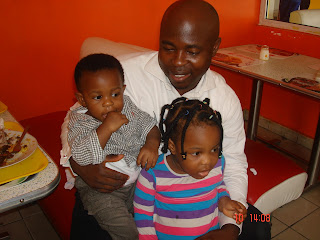 My hubby and kids
Of course, the first relationship I experienced was that of my parents and siblings. We all stayed together as a nuclear family with cousins, aunts, uncles and other relatives coming to visit. I learnt from everyone in my family as I am the second to the last child. My mum paid attention to our school work and made sure we showed her our finished pens before she could issue another one. She made me recite the national anthem and the multiplication table and on the other hand my dad was more concerned with providing our needs like shelter, clothing, food, etc. It was like a shared responsibility. It was fun with my siblings because we played together and then still disagreed when the need arose. As a result of this, I was able to build a 'tough' skin that I was not scared of been bullied. Teasing was part of the game at home.
We still share such relationships now that we all grown but on a more mature tone.
Presently, I am married to Benneth and we've got two loving kids-Gavrila and Azriel. I try my best to relate so closely with my immediate family knowing the benefits and rewards. As a potential early childhood professional, I inform my husband on how best to relate with our kids; as a wife and mother I have learnt to play these roles independently.
Outside my family life, I relate with a couple of people around me. I've got some very close friends whom I chat with regularly. My nieces and nephews are so special to me. I make them feel free to tell me whatever is their problem. Once in a while I speak with my former lecturer and classmates. I seldom communicate with my pastor-friend from whom I have gained so much spiritually. I am in the process of building a relationship with my children's caregivers; but a barrier here is the difference in language. I speak English and my son's caregiver is French. I am trying so hard to learn French so as to break this jinx. Above all, my relationship with my husband and two kids is paramount to me presently.
Building relationships require an amount of effort. Like it is popularly said, ''if you want a friend then you be a friend too''. Initially there might be a barrier of ego, culture diversity, racism, lack of interest, etc. I am currently living in France and it's been quite a challenge mixing up with the French because of the language barrier and where there's no understanding there can't be a relationship.
For me, communication is the bedrock of relationships. I make an effort to use my smartphone to maintain these relationships. I call my mum almost on a daily basis. I gist with my children about anything they need to know, I gist and discuss with my husband.
I think one relationship I foresee to becoming partnership is that between me and my children's caregivers, because I relate with them as colleagues doing the same job as me. Though not there yet.
I have extended this act of building relationships to parents or family members of children I am working with. Knowing there are several benefits to building relationships, I hope to offer my best to children and families so as to achieve rewards that are beneficial to families and the society. These benefits may include a lesser rate of crime in the society, children showing more interest to further their education, children becoming loving and caring adults, etc.
 My hubby and kids
Subscribe to:
Posts (Atom)