Living in France with just my hubby and kids has been quite challenging because there are no relatives to help when I am choked up with chores and academic work. But thanks to the French system that has made provision for child-care centres.
My greatest supports are my children's school and care minder respectively. My daughter who is 4 stays in school till 4.45pm daily except on Wednesdays and my son (2yrs old) who found it difficult adjusting initially stays with his care minder till 5pm daily except on Wednesdays which he stays home with me all day. I try to do all I have to do during school hours and make sure I spend the remaining part of the evenings with my husband and kids. Just of recent I was able to talk my husband into participating in school runs which he gladly does now, so it is much better for me than it used to be last year. Calls I receive from my mum in Nigeria almost on a daily basis keep me going, indeed she is my emotional support after my husband. Financially, my husband has been very supportive--Kudos to him.
It was pretty difficult initially when my daughter stayed at school till 11.30am and my son was home with me everyday. School runs was not palatable as I had to drop her by 9am and then pick her in the next 2hrs. Without the support of my hubby and children's school, maybe I wouldn't have been able to meet up with my academics and other social engagements. Thanks to them all.
Friday, October 11, 2013

Saturday, September 28, 2013
My Connections to Play
Play used to be fun and enjoyable. One vivid thing I remember was that we rarely played inside the house. We always played outside running around with friends, played with sand, did pretend cooking with grass and sand. Hide and seek was one of my delights. We went to the beach almost every weekend where I had the opportunity to taste the salty water and walked bare footed feeling the different sand texture. Play was a part of my everyday life, I was asked not to play only if I misbehaved or had some tests to do at school. I had very few toys compared to what any child in the 21st century would have.
Sincerely, I think we were allowed such an amount of play because our parents and older siblings saw us as disturbances at home, so for this reason the door was always opened for us to go play. I don't think our parents knew of any benefits of play. But thanks to instinct!
I was very shy as a kid but I remember I never used to be shy when I played with my friends, probably the 'plays' I had then made me overcome shyness. Through play, I was able to listen and learn of some African folk tales. But today, children mostly play indoors with lots of toys and technological gadgets. Due to the security situation, children no more have the freedom to play in the neighbourhood. Staying indoors always will prevent children from having a feel of nature. The amount of play I had as a child help me relate well with people because I was able to socialize while I played.
I hope to be an advocate in this area and sincerely wish that the old era of play be restored.
The following quotes summarize my 'play life' as a kid:
''You can't stop the future,
You can't rewind the past,
The only way to learn the secret is to press play''. Jah Asher
''Combinatory play seems to be the essential feature in productive thought''. Albert Einstein
''Play gives children a chance to practice what they are learning''. Mr. Rogers
''The creation of something new is not accomplished by the intellect but by the play instinct''. Carl Jung
''Play is often talked about as if it were a relief from serious learning. But for children play is serious learning. Play is really the work of children.'' Fred Rogers
''Do not keep children to their studies by compulsion but by play.'' Plato

Sincerely, I think we were allowed such an amount of play because our parents and older siblings saw us as disturbances at home, so for this reason the door was always opened for us to go play. I don't think our parents knew of any benefits of play. But thanks to instinct!
I was very shy as a kid but I remember I never used to be shy when I played with my friends, probably the 'plays' I had then made me overcome shyness. Through play, I was able to listen and learn of some African folk tales. But today, children mostly play indoors with lots of toys and technological gadgets. Due to the security situation, children no more have the freedom to play in the neighbourhood. Staying indoors always will prevent children from having a feel of nature. The amount of play I had as a child help me relate well with people because I was able to socialize while I played.
I hope to be an advocate in this area and sincerely wish that the old era of play be restored.
The following quotes summarize my 'play life' as a kid:
''You can't stop the future,
You can't rewind the past,
The only way to learn the secret is to press play''. Jah Asher
''Combinatory play seems to be the essential feature in productive thought''. Albert Einstein
''Play gives children a chance to practice what they are learning''. Mr. Rogers
''The creation of something new is not accomplished by the intellect but by the play instinct''. Carl Jung
''Play is often talked about as if it were a relief from serious learning. But for children play is serious learning. Play is really the work of children.'' Fred Rogers
''Do not keep children to their studies by compulsion but by play.'' Plato


As a kid, I enjoyed pretend play
Saturday, September 14, 2013
Relationship Reflection
Human beings generally are social beings and that explains why everyone is in a midst of several relationships ranging from families, friends, colleagues, acquaintance, etc. No wonder someone once said that the worst disease on earth is not HIV/AIDS but a feeling of loneliness and or rejection. Humans are meant to strive in the midst of relationships because no one just appeared from the sky--Everyone has got a link. Relationships are essential to our daily lives because needs are met when relationships exist; it could be a distant or close relationship.
Of course, the first relationship I experienced was that of my parents and siblings. We all stayed together as a nuclear family with cousins, aunts, uncles and other relatives coming to visit. I learnt from everyone in my family as I am the second to the last child. My mum paid attention to our school work and made sure we showed her our finished pens before she could issue another one. She made me recite the national anthem and the multiplication table and on the other hand my dad was more concerned with providing our needs like shelter, clothing, food, etc. It was like a shared responsibility. It was fun with my siblings because we played together and then still disagreed when the need arose. As a result of this, I was able to build a 'tough' skin that I was not scared of been bullied. Teasing was part of the game at home.
We still share such relationships now that we all grown but on a more mature tone.
Presently, I am married to Benneth and we've got two loving kids-Gavrila and Azriel. I try my best to relate so closely with my immediate family knowing the benefits and rewards. As a potential early childhood professional, I inform my husband on how best to relate with our kids; as a wife and mother I have learnt to play these roles independently.
Outside my family life, I relate with a couple of people around me. I've got some very close friends whom I chat with regularly. My nieces and nephews are so special to me. I make them feel free to tell me whatever is their problem. Once in a while I speak with my former lecturer and classmates. I seldom communicate with my pastor-friend from whom I have gained so much spiritually. I am in the process of building a relationship with my children's caregivers; but a barrier here is the difference in language. I speak English and my son's caregiver is French. I am trying so hard to learn French so as to break this jinx. Above all, my relationship with my husband and two kids is paramount to me presently.
Building relationships require an amount of effort. Like it is popularly said, ''if you want a friend then you be a friend too''. Initially there might be a barrier of ego, culture diversity, racism, lack of interest, etc. I am currently living in France and it's been quite a challenge mixing up with the French because of the language barrier and where there's no understanding there can't be a relationship.
For me, communication is the bedrock of relationships. I make an effort to use my smartphone to maintain these relationships. I call my mum almost on a daily basis. I gist with my children about anything they need to know, I gist and discuss with my husband.
I think one relationship I foresee to becoming partnership is that between me and my children's caregivers, because I relate with them as colleagues doing the same job as me. Though not there yet.
I have extended this act of building relationships to parents or family members of children I am working with. Knowing there are several benefits to building relationships, I hope to offer my best to children and families so as to achieve rewards that are beneficial to families and the society. These benefits may include a lesser rate of crime in the society, children showing more interest to further their education, children becoming loving and caring adults, etc.
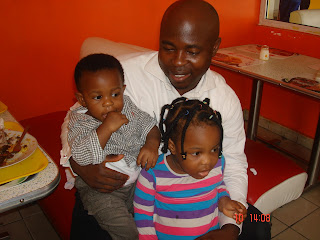 My hubby and kids
Of course, the first relationship I experienced was that of my parents and siblings. We all stayed together as a nuclear family with cousins, aunts, uncles and other relatives coming to visit. I learnt from everyone in my family as I am the second to the last child. My mum paid attention to our school work and made sure we showed her our finished pens before she could issue another one. She made me recite the national anthem and the multiplication table and on the other hand my dad was more concerned with providing our needs like shelter, clothing, food, etc. It was like a shared responsibility. It was fun with my siblings because we played together and then still disagreed when the need arose. As a result of this, I was able to build a 'tough' skin that I was not scared of been bullied. Teasing was part of the game at home.
We still share such relationships now that we all grown but on a more mature tone.
Presently, I am married to Benneth and we've got two loving kids-Gavrila and Azriel. I try my best to relate so closely with my immediate family knowing the benefits and rewards. As a potential early childhood professional, I inform my husband on how best to relate with our kids; as a wife and mother I have learnt to play these roles independently.
Outside my family life, I relate with a couple of people around me. I've got some very close friends whom I chat with regularly. My nieces and nephews are so special to me. I make them feel free to tell me whatever is their problem. Once in a while I speak with my former lecturer and classmates. I seldom communicate with my pastor-friend from whom I have gained so much spiritually. I am in the process of building a relationship with my children's caregivers; but a barrier here is the difference in language. I speak English and my son's caregiver is French. I am trying so hard to learn French so as to break this jinx. Above all, my relationship with my husband and two kids is paramount to me presently.
Building relationships require an amount of effort. Like it is popularly said, ''if you want a friend then you be a friend too''. Initially there might be a barrier of ego, culture diversity, racism, lack of interest, etc. I am currently living in France and it's been quite a challenge mixing up with the French because of the language barrier and where there's no understanding there can't be a relationship.
For me, communication is the bedrock of relationships. I make an effort to use my smartphone to maintain these relationships. I call my mum almost on a daily basis. I gist with my children about anything they need to know, I gist and discuss with my husband.
I think one relationship I foresee to becoming partnership is that between me and my children's caregivers, because I relate with them as colleagues doing the same job as me. Though not there yet.
I have extended this act of building relationships to parents or family members of children I am working with. Knowing there are several benefits to building relationships, I hope to offer my best to children and families so as to achieve rewards that are beneficial to families and the society. These benefits may include a lesser rate of crime in the society, children showing more interest to further their education, children becoming loving and caring adults, etc.
 My hubby and kids
Friday, June 28, 2013
When I Think of Child Development...
Then I wish all of these quotes could come true for our children:
I have also seen children successfully surmounting the effects of an evil inheritance. That is due to purity being an inherent attribute of the soul- Mahatma Gandhi.
Children must be taught how to think, not what to think- Margaret Mead.
I would be most content if my children grew up to be the kind of people who think decorating consists mostly of building enough book shelves- Anna Quindlen.
Children are made readers on the laps of their parents- Emilie Buchwald.
Nothing you do for children are ever wasted- Garrison Keiller.
It is easier to build strong children than to repair broken men- Fredrick Douglass.
There can be no keener revelation of a society's soul than the way in which it treats its children- Nelson Mandela.
Those who educate children well are more to be honoured than they who produce them; for these only gave them life, those the art of living well- Aristotle.
I have also seen children successfully surmounting the effects of an evil inheritance. That is due to purity being an inherent attribute of the soul- Mahatma Gandhi.
Children must be taught how to think, not what to think- Margaret Mead.
I would be most content if my children grew up to be the kind of people who think decorating consists mostly of building enough book shelves- Anna Quindlen.
Children are made readers on the laps of their parents- Emilie Buchwald.
Nothing you do for children are ever wasted- Garrison Keiller.
It is easier to build strong children than to repair broken men- Fredrick Douglass.
There can be no keener revelation of a society's soul than the way in which it treats its children- Nelson Mandela.
Those who educate children well are more to be honoured than they who produce them; for these only gave them life, those the art of living well- Aristotle.
Saturday, June 15, 2013
Intelligence Test
In my opinion, since human is made of three main parts, body, soul and spirit, then children should be assessed on these three areas to determine their wholesome development. For the body, physical activities like sports, dancing, personal hygiene etc. would be part of the assessing package. The soul could be assessed with cognitive activities like reading, school/academic work-maths, English, music, literature; and the development of the spirit could be tested by some sort of religious activities like meditation, religious studies, etc. Sounds a bit awkward here, I guess
In Malaysia, school age children are tested by written exams which whether passed or not leads to promotion to the next class. By age 7, children should be in primary school and it lasts for 6yrs. Between 1996-2000, the Level One Evaluation (Penitaian Tahap Satu) was administered to year 3 students which when passed, will lead to a double promotion from year3 to 5 but was stopped because parents were putting undue pressure on their children to pass this exam. To move on to secondary school, the Primary School Achievement Test (Ujan Pencapaian Sekolah Renda) must be written. The subjects tested are Malay comprehension, written Malay, English, Science and Mathematics. In addition to the five subjects, Chinese comprehension and written Chinese are compulsory in Chinese schools, while Tamil comprehension and written Tamil are compulsory in Tamil schools. Aptitude tests are also written and then multiple choice is tested using optical answer paper sheet which is also marked by an optical machine.
It's quiet unfortunate that most countries and schools test children mainly on academic achievement. I believe talents and natural abilities should be nurtured. Adding education to any talent one has will go a long way in making a big difference. But it seems most people go for one and not both. Most people who are making good use of their talents have little or no education and most people who have good academic degrees have swept their talents under the carpet and are just pursuing career.
Source
https://en.wikipedia.org/wiki/Education_in_Malaysia
In Malaysia, school age children are tested by written exams which whether passed or not leads to promotion to the next class. By age 7, children should be in primary school and it lasts for 6yrs. Between 1996-2000, the Level One Evaluation (Penitaian Tahap Satu) was administered to year 3 students which when passed, will lead to a double promotion from year3 to 5 but was stopped because parents were putting undue pressure on their children to pass this exam. To move on to secondary school, the Primary School Achievement Test (Ujan Pencapaian Sekolah Renda) must be written. The subjects tested are Malay comprehension, written Malay, English, Science and Mathematics. In addition to the five subjects, Chinese comprehension and written Chinese are compulsory in Chinese schools, while Tamil comprehension and written Tamil are compulsory in Tamil schools. Aptitude tests are also written and then multiple choice is tested using optical answer paper sheet which is also marked by an optical machine.
It's quiet unfortunate that most countries and schools test children mainly on academic achievement. I believe talents and natural abilities should be nurtured. Adding education to any talent one has will go a long way in making a big difference. But it seems most people go for one and not both. Most people who are making good use of their talents have little or no education and most people who have good academic degrees have swept their talents under the carpet and are just pursuing career.
Source
https://en.wikipedia.org/wiki/Education_in_Malaysia
Saturday, June 1, 2013
Consequences of Stress on Children Development
Noise is a common stressor in most African countries. I know of someone who grew up in a noisy part of Nigeria. She got accustomed to all manner of noise like horn blasts, children screaming and shouting while playing, noise of old cars and lorries, noise of heavy duty machines, very loud music of neighbours, etc. To this effect, she finds it difficult to sleep in a quiet or peaceful environment and may have to play some music while she sleeps. Reading without a music playing for is her is almost impossible as she said she does not enjoy silence. For me, I think it might be difficult for her to meditate or concentrate as these skills are needed for cognitive development. I feel this would have affected her ears too as she hardly hears low tone conversation and shouts while making phone calls. She probably might end up being a shouting parent in my opinion.
As I thought of a country to study about, South African Apartheid came to my mind and I am glad I did a research on it. I used to believe that apartheid has been completely eradicated in South Africa, but to my utmost surprise, I read that it still exists. South Africa has in existence more than one stressor like racism, violence, disease, hunger and poverty. South Africa has been called one of the most psychologically ill societies in the world because of the following reasons: high rates of family violence
It's among the highest divorced rate countries in the world
Fifth highest in the world coronary disease
Has a high rate of motor accident
Experience traumas linked to political unrest .
South Africans (Blacks) still face racism daily as it is reported that a black child is 18times more likely to grow up poor than his/her white counterpart. About 60% of children survive on 575rand($67 or 51euros); or around 2/3 of black children that are 18yrs and only 2% of white children--this is incredible! Ironically, out of 10million children, 8million are blacks.
All these of course affect their development. They have a high rate of disease amongst the children and malnutrition is common in the rural areas. 1/3 of under 14 are stunted and under weight. Some schools for the blacks lack cognitive tools to teach hence they are mentally retarded.
Sources:
AFP, 2012,Oct 17. South African Children still face apartheid- like inequality. Retrieved from
http://www.google.com/hostednews/afp/article/ALeqM5i2lY455I6yN3_HCfTOk4mONdAe9A?docId=CNG.c87c030182d8aa078508c64fcad776ba.3b1
Hickson & Kriegler (1991, June). The effects of apartheid on the mental health of South African Children. International Journal for the advancement of counselling Retrieved from http://link.springer.com/article/10.1007%2FBF00117733
As I thought of a country to study about, South African Apartheid came to my mind and I am glad I did a research on it. I used to believe that apartheid has been completely eradicated in South Africa, but to my utmost surprise, I read that it still exists. South Africa has in existence more than one stressor like racism, violence, disease, hunger and poverty. South Africa has been called one of the most psychologically ill societies in the world because of the following reasons: high rates of family violence
It's among the highest divorced rate countries in the world
Fifth highest in the world coronary disease
Has a high rate of motor accident
Experience traumas linked to political unrest .
South Africans (Blacks) still face racism daily as it is reported that a black child is 18times more likely to grow up poor than his/her white counterpart. About 60% of children survive on 575rand($67 or 51euros); or around 2/3 of black children that are 18yrs and only 2% of white children--this is incredible! Ironically, out of 10million children, 8million are blacks.
All these of course affect their development. They have a high rate of disease amongst the children and malnutrition is common in the rural areas. 1/3 of under 14 are stunted and under weight. Some schools for the blacks lack cognitive tools to teach hence they are mentally retarded.
Sources:
AFP, 2012,Oct 17. South African Children still face apartheid- like inequality. Retrieved from
http://www.google.com/hostednews/afp/article/ALeqM5i2lY455I6yN3_HCfTOk4mONdAe9A?docId=CNG.c87c030182d8aa078508c64fcad776ba.3b1
Hickson & Kriegler (1991, June). The effects of apartheid on the mental health of South African Children. International Journal for the advancement of counselling Retrieved from http://link.springer.com/article/10.1007%2FBF00117733
Friday, May 17, 2013
Child Development and Public Health
Breast Feeding.
Exclusive breastfeeding refers to feeding an infant with breast milk only without any other liquid or supplement during the first six months. From research this has a load of benefits to both mother and child. Exclusive breastfeeding has a potential to prevent at least 13%of all under five death in developing countries. Also, it could help avert about 55-87% of neonatal deaths.
Other benefits include:
It's easier to digest than formular
It fights diseases in children and mothers
Saves money
Helps mother-child bonding
It could help reduce the rate of breast & ovarian cancer, type 2 diabetes, postpatum depression, etc in women.
When breastfeeding as a woman,the oxytocin hormones are produced which can calme the woman.
Breastfeeding protects from risk of contaminated water supply in developing countries epecially
It has the right temperature and hence helps prevent hypothermia -a state where the body temperature drops below normal
For me, breastfeeding is most appropriate for infants; After reading the numerous benefits, I came to this conclusion. I practiced exclusive breastfeeding with my kids. Breastfeeding is meaningful to me because it's the cheapest means of protecting these littles from illness and malnutrition at the early stage of life particulary in the developing countries where the standard of living is relatively low.
Intrestingly, in Kuwait (one of the richest countries in the world), breastfeeding is not a popular practice due to the fact that formulars are well subsidized by the government and inadequate professional support. Mothers begin to give their babies water, juice and herbs from the very first month and about 32.8% below six months use bottles. Some other misconceptions about breastfeeding is that breast milk is not sufficient for infants; it is only meant for babies who came through ceaserean section, and only babies who spent some time in special care wards may need it. But, science has shown how small babies' stomachs are and that breast milk is just sufficient for this size, also all babies need breast milk whether full term or premature babies.
As a result of this, there's a high rate of 24% of chronic malnutrition amongst children who are under 5yrs of age in Kuwait despite her wealth.
From this data, breastfeeding could be beneficial to women and children in developing countries as it can reduce greatly the rate of malnutrition (one of the causes of infant deaths in developing countries).
Being aware of this information, I would be an advocate in this area by telling as many mothers (even fathers) that I know the benefits of breastfeeding. This information has also helped me in erasing my ignorance--before now, I used to think breast milk is not sufficient for twins or tripplets, but from research, reverse is the case. So, mothers with twins and tripplets could go ahead with exclusive breast feeding for some months(Berger, 2012). But the challenge here is with working mothers who especially are the breadwinners of their home--it might be pretty difficult to cope with exclusive breastfeeding
References
http://worldbreastfeedingtrends.org
http://unicef.org/media/images/fact_sheet.doc
http://womenhealth.gov
Exclusive breastfeeding refers to feeding an infant with breast milk only without any other liquid or supplement during the first six months. From research this has a load of benefits to both mother and child. Exclusive breastfeeding has a potential to prevent at least 13%of all under five death in developing countries. Also, it could help avert about 55-87% of neonatal deaths.
Other benefits include:
It's easier to digest than formular
It fights diseases in children and mothers
Saves money
Helps mother-child bonding
It could help reduce the rate of breast & ovarian cancer, type 2 diabetes, postpatum depression, etc in women.
When breastfeeding as a woman,the oxytocin hormones are produced which can calme the woman.
Breastfeeding protects from risk of contaminated water supply in developing countries epecially
It has the right temperature and hence helps prevent hypothermia -a state where the body temperature drops below normal
For me, breastfeeding is most appropriate for infants; After reading the numerous benefits, I came to this conclusion. I practiced exclusive breastfeeding with my kids. Breastfeeding is meaningful to me because it's the cheapest means of protecting these littles from illness and malnutrition at the early stage of life particulary in the developing countries where the standard of living is relatively low.
Intrestingly, in Kuwait (one of the richest countries in the world), breastfeeding is not a popular practice due to the fact that formulars are well subsidized by the government and inadequate professional support. Mothers begin to give their babies water, juice and herbs from the very first month and about 32.8% below six months use bottles. Some other misconceptions about breastfeeding is that breast milk is not sufficient for infants; it is only meant for babies who came through ceaserean section, and only babies who spent some time in special care wards may need it. But, science has shown how small babies' stomachs are and that breast milk is just sufficient for this size, also all babies need breast milk whether full term or premature babies.
As a result of this, there's a high rate of 24% of chronic malnutrition amongst children who are under 5yrs of age in Kuwait despite her wealth.
From this data, breastfeeding could be beneficial to women and children in developing countries as it can reduce greatly the rate of malnutrition (one of the causes of infant deaths in developing countries).
Being aware of this information, I would be an advocate in this area by telling as many mothers (even fathers) that I know the benefits of breastfeeding. This information has also helped me in erasing my ignorance--before now, I used to think breast milk is not sufficient for twins or tripplets, but from research, reverse is the case. So, mothers with twins and tripplets could go ahead with exclusive breast feeding for some months(Berger, 2012). But the challenge here is with working mothers who especially are the breadwinners of their home--it might be pretty difficult to cope with exclusive breastfeeding
References
http://worldbreastfeedingtrends.org
http://unicef.org/media/images/fact_sheet.doc
http://womenhealth.gov
Subscribe to:
Posts (Atom)